
A face behind the reply.
A provider photo and ID make the introduction personal. Messages and photos give the clinician context.
For employers & health plans
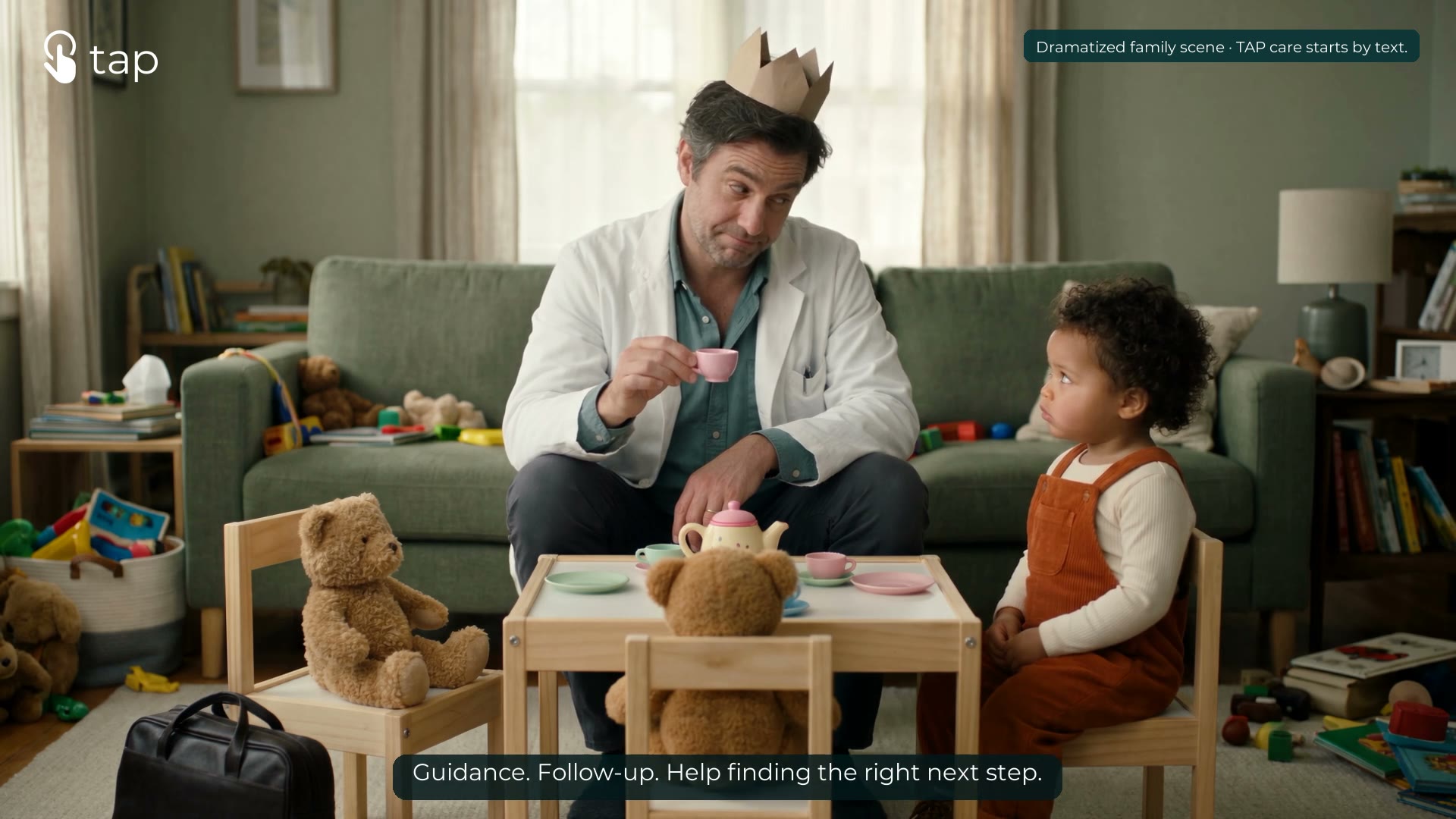
Imagine your doctor saying, “Here’s my number. Text me anytime.” That feeling of having someone in your corner is the idea behind TAP.
One saved contact.
A conversation that keeps going.
Text, photos, clinical guidance and follow-up—with a team you can come back to.

Today · 9:41 AM
Later · After clinical review
Not live quotes · Tap a pharmacy to try it.
That evening · Same conversation
A place to return to.
The family scenes and example conversation are dramatizations; actual TAP care begins by text with a clinical team. Access steps vary by service and plan. The film uses FEP as an example for evaluating incremental value, and does not announce a partnership, a member benefit or an approved pilot.
Care that stays connected
The doctor in the family is the feeling. The clinical team behind the number is the service.
A provider photo and ID make the introduction personal. Messages and photos give the clinician context.
Clinical review comes first. Then practical guidance, from choosing a pharmacy to finding the right next care setting.
Return to the same conversation later in the day. Follow-up keeps care connected to what happens next.
The parent and child are fictional. The inhaler refill follows clinical review; prescriptions are not guaranteed. Pharmacy prices of $18, $29, $42 and $68 are illustrative, not live quotes. The $50 range is not a promise of savings; availability, coverage and prices vary. Condensed messages and an evening check-in do not establish a universal response or follow-up deadline. “Text me anytime” describes the invitation to reach out, not a clinician’s private cell phone or continuous personal availability.
Explore the public TAP experience and first-text walkthrough.
Experience worth examining
Employer engagement and community experience can inform a thoughtful evaluation. Each answers a different question.
One early city employee program
Company-reported, up to70%
TAP reports this result for one early city employee program. The cohort, eligibility denominator and definition of engagement still need validation. It is an initial company-reported signal, not a portfolio average, a forecast for another plan or evidence of claims savings.
Community experience · Chesterfield
TAP’s April 2026 case study reports community use at this scale. The unit is patient encounters, which can include repeat users. This is not a count of unique people or verified avoided visits.
Read the public community case study ↗Employer-benefit distribution · TXHB
TAP’s July 2026 announcement describes its selection for Texas Health Benefits Pool members, with phased enrollment beginning in September 2026. This shows a route into employer benefits; it does not establish utilization or endorsement by another carrier.
Read the TXHB announcement ↗These are company-reported sources. Community encounters, self-reported alternative care and modeled community value are different measures from claims-confirmed avoided care, employer absence or net plan savings. The proposed evaluation below is designed to distinguish them.
For the decision-maker
The hypothesis is straightforward: a more familiar path to a clinical team can increase useful engagement. An evaluation should then establish whether that changes care and total cost.
Start with the eligible employee and family roster, activation and unique use. Track repeat engagement, employee experience, follow-up and connection with existing care. If absence is an endpoint, validate it with appropriate employer records rather than treating a survey estimate as payroll evidence.
Start with the current benefit and a defined comparison population. Establish whether TAP adds appropriate engagement, changes urgent-care or ER use, supports primary-care connections and affects total allowed cost after TAP fees and any incremental care.
Unique eligible users divided by the agreed eligible population, with activation dates, observation period, employee/dependent mix and repeat use shown separately.
Clinical disposition, follow-up, escalation, primary-care linkage and patient experience—then claims-based ER and urgent-care utilization when data are available.
Allowed costs across care settings, including TAP fees and incremental care. Account for baseline differences, selection, risk and claims runout before drawing conclusions.
Eligible population and family definitions; baseline and comparison design; implementation and outreach; clinical scope and escalation; data access and privacy; observation period and claims runout; fee denominator; owners, milestones and success criteria. This is a proposed framework, not an approved pilot or a savings guarantee.
FEP is one example discussed in the film. FEP already offers telehealth services, so the relevant question is incremental value alongside the existing benefit. No FEP or Anthem affiliation, procurement decision or endorsement is implied.
A family-level price
per family, per month.
Current company pricing. Family eligibility, covered services, implementation, minimums and final terms must be agreed. This is a family rate; a per-member equivalent requires a documented family-size denominator.
Illustration: families × $9 × 12 months. Assumes a constant family count. It does not include unagreed implementation or other costs, or estimate utilization or savings.
Start with the people you serve
Bring the population, the existing benefit and the questions that matter. Together, we can define what useful engagement should look like.